EdTechplatformdevelopment,from20,000to250,000dailyusers.
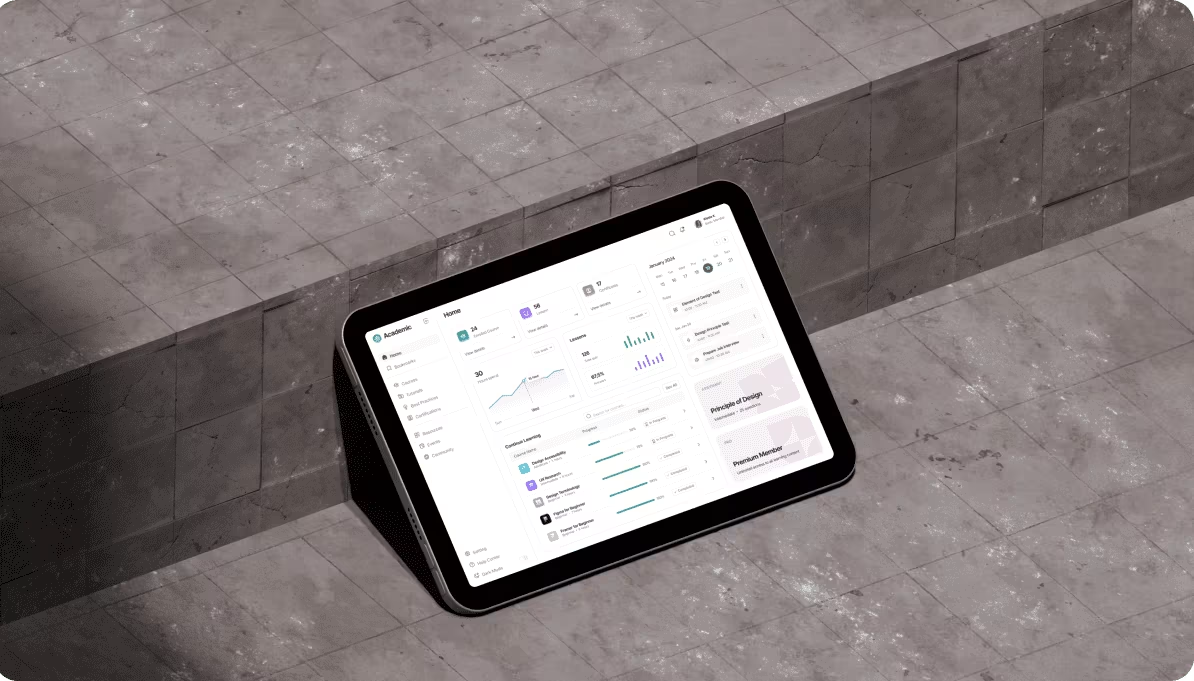
This is the multi-tenant EdTech platform we build and run ourselves. It grew 12x over three years and now takes 10 million requests a minute at peak, with zero downtime across three migrations. White-label brands like Your CA Buddy and Youth Pathshala sit on top of it.
Daily active users
Peak requests per minute
User growth over 3 years
Downtime through 3 migrations
EdTech platform development, what we actually built.
It's a multi-tenant EdTech platform. Several white-label education brands run on top of it, on one shared piece of scaling infrastructure. Your CA Buddy and Youth Pathshala are two of them. Each brand keeps its own look, its own configuration, and a data path no other tenant can touch, and yet they all sit on the same production codebase.
We started at 20,000 daily active users. Three years of custom development later, it carries 250,000+ DAU at 10M+ requests a minute when the load peaks. Zero downtime, even across three scaling migrations. One thing we want to be clear about. This isn't a build we shipped for a client and then walked away from. It's the platform our own team builds and operates, every single day.
Stopping the bleeding.
It all started on a monolith. One primary database was pulling triple duty, acting as the transactional store and the cache and the analytics engine at the same time, which is fine until it isn't. Login flows ran synchronously. Assignment submissions wrote straight to that same primary database. So every Monday at 8:00 AM, when twenty thousand students all logged in inside a 90-second window, the whole thing buckled.
Authentication was the first thing we pulled apart. We moved auth onto its own service, swapped session-based tokens for JWTs, and stood up read replicas so session validation never hit the primary database. The login storm got its own dedicated auth cluster. What used to be a platform-wide Monday-morning slowdown turned into a 3-second blip nobody complained about.
Submissions came next. Rather than writing directly to the database, they now go through a queue with guaranteed delivery. The single worst endpoint on the platform dropped its p99 latency by 80 percent. Inside of 90 days the weekly outages were just gone.
From 50,000 to 200,000 daily users.
With the platform stable, we rebuilt it for scale. The monolith broke apart into focused services, one each for authentication, content delivery, submissions, reporting, and analytics. Every service owned its own data and could scale on its own, without dragging the others along.
We put a CDN in front of every bit of video. Caches got pre-warmed ahead of scheduled live sessions, so the rush never caught us cold. Adaptive bitrate streaming took care of the students on patchy connections. And reporting moved to its own analytics database with materialized views. Teacher dashboards that used to grind for 14 seconds were now loading in under one.
Then we rolled out multi-region deployment for the biggest geographies. A student in one time zone now hits the edge nearest them, not a server on the other side of the world. By the end of this phase the platform was serving 200,000 daily active users, and its p99 latency was actually better than it had been back at 20,000.
One platform. Multiple white-label brands.
Once the core was hardened, we built multi-tenancy on top so a new brand could come online without anyone shipping code. Row-level security keeps each tenant's data walled off from the rest. Branding is driven entirely by configuration, every tenant gets its own data path, and a brand can provision itself rather than waiting on us.
Your CA Buddy and Youth Pathshala both run on this same infrastructure today. A new brand goes live in days now, not weeks. Across the full tenant list, the platform serves 250,000+ daily active users at 10M+ requests a minute when it peaks.
Three scaling migrations, zero downtime. 12x growth in users. Same team the whole way, same platform, three years of building on it without ever stopping.
The engineering behind the EdTech platform.
Architecture
- →Monolith-to-microservices migration
- →Event-driven async processing
- →CQRS pattern for reporting
- →Multi-region active-active deployment
Data
- →Primary/replica database architecture
- →Dedicated analytics database with materialized views
- →Redis caching tier for hot data
- →Queue-based write buffering for peak loads
Delivery
- →CDN-aware video infrastructure
- →Adaptive bitrate streaming
- →Edge caching for static content
- →Pre-warmed caches for scheduled events
Five principles every EdTech founder should know.
- 01
The jump from 50,000 to 150,000 daily users breaks more platforms than the jump from 150,000 to 250,000. The second is engineering. The first is architecture.
- 02
Your database is not the bottleneck at scale. Your session layer is.
- 03
You cannot CDN your way out of a login storm. You have to rebuild the authentication flow.
- 04
Every 'temporary' solution shipped at 50,000 users becomes a six-month rebuild at 200,000.
- 05
The feature that costs you customers at scale is not one you built badly. It is one you built before you understood how it would be used.
The EdTech platform development stack.
Planning your own EdTech platform development?
Maybe you're hitting one of the walls we've already climbed over. Maybe you're about to build the thing that hits them. Either way, book a free 30-minute scoping call and we'll map out cost, timeline, and the architecture for your build. No pitch, no pressure, just a straight read on what it takes.
You'd be talking to the team that builds and runs a platform at 250K+ daily active users and 10M+ requests a minute, with 50+ products shipped and a 4.9 star rating across 24+ client projects.
Get a free, fixed-scope estimate